
For many merchants, especially those operating in online or high-risk industries, payment processing comes with terms that are not always immediately clear. One of the most commonly misunderstood concepts is the rolling reserve.
Merchants often encounter rolling reserves after onboarding with a payment provider, sometimes without fully understanding how it impacts cash flow and operations.
A rolling reserve is not a penalty—it is a risk management mechanism used by payment providers to ensure stability within the payment ecosystem.
With Paysking, businesses gain access to transparent and scalable payment infrastructure that helps manage rolling reserves while maintaining smooth payment operations.
Understanding how rolling reserves work allows merchants to plan effectively and avoid operational disruptions.
What Is a Rolling Reserve in Payment Processing
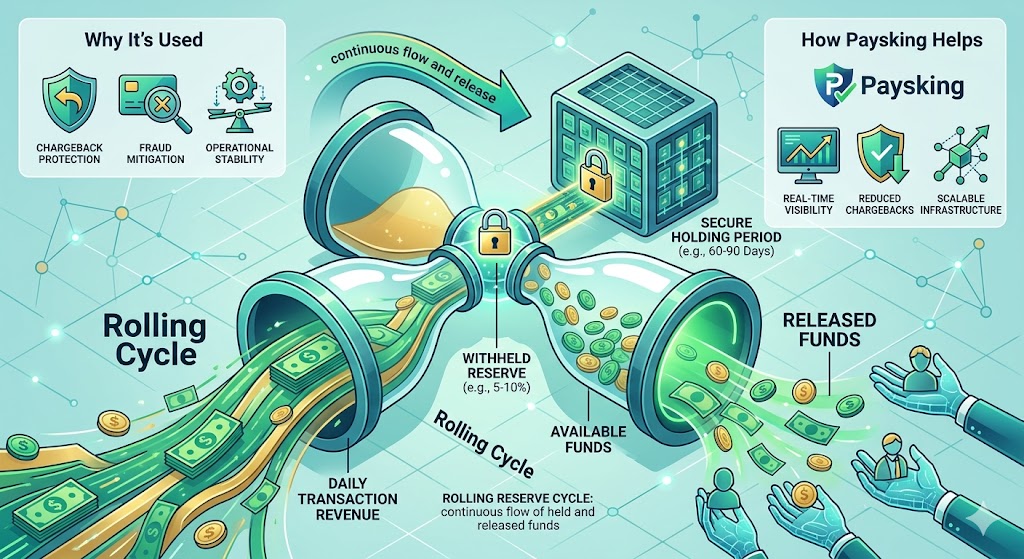
A rolling reserve is a percentage of a merchant’s transaction revenue that is temporarily held by a payment processor.
Instead of receiving full payouts immediately, a portion of funds is withheld for a specific period before being released.
How It Works
For example:
- A merchant processes daily transactions
- A fixed percentage (e.g., 5–10%) is held
- Funds are released after a defined period (e.g., 60–90 days)
This structure creates a rolling cycle where funds are continuously held and released.
Rolling reserves are especially common for businesses classified as high risk, as explained in
👉 https://paysking.com/what-is-a-high-risk-merchant-account-and-why-might-your-business-need-one/
Why Payment Providers Use Rolling Reserves
Rolling reserves are used to manage financial risk and protect payment ecosystems.
Chargeback Protection
If customers dispute transactions, payment providers need funds available to cover refunds and chargebacks.
Chargeback prevention plays a key role in reducing reserve requirements, as outlined in
👉 https://paysking.com/chargeback-prevention-strategies-for-high-risk-businesses/
Fraud Risk Mitigation
High-risk industries may experience higher fraud rates. Reserves provide financial protection against potential losses.
Operational Stability
Reserves ensure that payment providers can maintain stable operations even during disputes or financial fluctuations.
When Rolling Reserves Are Applied
Not all businesses are subject to rolling reserves. They are typically applied under specific conditions.
High-Risk Industries
Industries with higher dispute or refund rates are more likely to have reserves.
These industries often face challenges similar to those discussed in
👉 https://paysking.com/top-payment-challenges-in-the-crypto-forex-gaming-industries/
New Businesses Without Processing History
Businesses with limited transaction history may be considered higher risk.
High Transaction Volumes
Large transaction volumes increase exposure to potential disputes.
Types of Rolling Reserve Structures
Rolling reserves can vary based on business risk profile.
Fixed Percentage Rolling Reserve
A set percentage of each transaction is held and released after a defined period.
Tiered Reserve Structure
Reserve percentages may change based on transaction performance and risk levels.
Dynamic Reserve Models
Modern payment systems adjust reserve requirements based on real-time data.
Understanding these structures helps merchants manage financial planning effectively.
Impact of Rolling Reserves on Cash Flow
Rolling reserves directly affect how merchants manage finances.
Reduced Immediate Liquidity
A portion of revenue is temporarily unavailable, requiring careful cash flow planning.
Predictable Release Cycles
Although funds are held, they are released on a predictable schedule.
Financial Planning Importance
Merchants must plan expenses, operations, and growth strategies around reserve structures.
Modern payment platforms provide visibility into reserves, aligned with
👉 https://paysking.com/payment-platform-for-businesses-paysking/
How to Reduce Rolling Reserve Requirements
Merchants can lower reserve requirements over time by demonstrating stability.
Maintain Low Chargeback Ratios
Fewer disputes reduce perceived risk.
Improve Payment Security
Secure systems reduce fraud and increase trust.
Security frameworks align with
👉 https://paysking.com/secure-payment-processing-fraud-prevention-paysking/
Optimize Payment Performance
Higher transaction success rates improve merchant reliability.
Performance optimization aligns with
👉 https://paysking.com/how-to-optimize-card-payment-processing-for-better-conversion-rates/
Build Processing History
Consistent performance over time helps reduce risk classification.
Role of Technology in Managing Rolling Reserves
Modern payment infrastructure improves reserve management.
Real-Time Reporting
Merchants can track reserve balances and release schedules.
Transaction Monitoring
Monitoring helps identify risks and improve performance.
Scalable Payment Systems
Growing businesses require infrastructure that supports increasing transaction volume.
Scalable systems align with
👉 https://paysking.com/scalable-payment-gateway-business-growth-paysking/
Technology helps merchants manage reserves more effectively.
How Paysking Helps Merchants Manage Rolling Reserves
Paysking provides payment infrastructure designed to simplify reserve management and improve financial visibility.
Paysking helps businesses:
- monitor reserve balances in real time
- reduce disputes and fraud
- improve transaction success rates
- maintain stable payment operations
- scale payment systems efficiently
These capabilities allow merchants to operate confidently while managing rolling reserve structures.
Paysking’s ecosystem ensures transparency and operational stability.
Common Misconceptions About Rolling Reserves
“Rolling Reserves Are Fees”
Rolling reserves are not fees—they are temporary holds that are released over time.
“Funds Are Lost”
Funds are not lost; they are held as a security measure and returned after the reserve period.
“Only High-Risk Businesses Have Reserves”
While more common in high-risk industries, reserves may also apply to new or rapidly growing businesses.
Future of Reserve Management in Payment Processing
Payment ecosystems are becoming more transparent and technology-driven.
Future trends include:
- dynamic reserve models
- real-time risk assessment
- automated reserve adjustments
- improved financial visibility
Businesses adopting modern payment systems will benefit from more flexible reserve structures.
Manage Your Payments with Confidence Using Paysking
Rolling reserves are an important part of payment processing, especially for businesses operating in complex or high-risk environments.
With Paysking, merchants gain access to secure, scalable, and transparent payment infrastructure designed to support stable operations and effective reserve management.
Manage your payments with confidence using Paysking and build a strong financial foundation for your business.
Hashtags
#RollingReserve #PaymentProcessing #MerchantAccounts #FintechSolutions #Paysking