
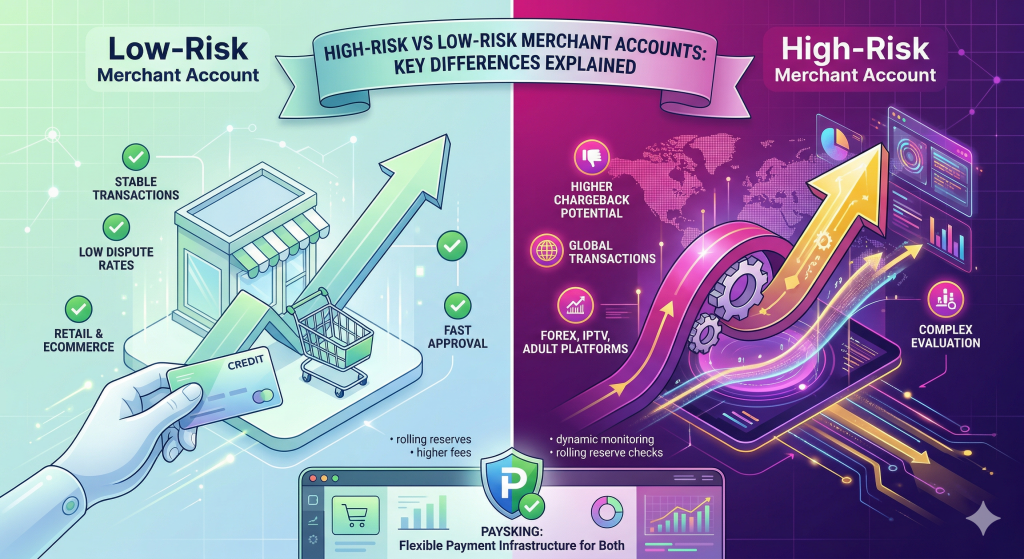
For businesses entering the world of online payments, one of the first concepts they encounter is merchant account classification. Payment providers categorize businesses as either high risk or low risk based on multiple factors such as industry, transaction patterns, and operational behavior.
This classification plays a critical role in determining whether your business gets approved, how much you pay in fees, and how stable your payment processing will be.
For beginner merchants, understanding the difference between high-risk and low-risk merchant accounts is essential.
With Paysking, businesses can access payment solutions tailored to their risk profile while ensuring scalability, compliance, and reliable transaction processing.
What Is a Merchant Account
A merchant account is a type of business account that allows companies to accept payments via credit cards, debit cards, and other digital payment methods.
It acts as an intermediary between your business, the customer’s bank, and the payment processor.
Modern payment systems are built on integrated platforms similar to
👉 https://paysking.com/payment-platform-for-businesses-paysking/
These systems ensure secure and efficient transaction handling.
What Is a Low-Risk Merchant Account
Low-risk merchant accounts are assigned to businesses that have stable transaction patterns, low dispute rates, and minimal regulatory complexity.
Characteristics of Low-Risk Businesses
- predictable sales volume
- low chargeback rates
- simple business models
- limited regulatory requirements
Examples of Low-Risk Industries
- retail stores
- basic eCommerce businesses
- local service providers
Low-risk businesses typically experience smoother onboarding and fewer restrictions.
What Is a High-Risk Merchant Account
High-risk merchant accounts are designed for businesses that operate in complex or higher-risk environments.
Characteristics of High-Risk Businesses
- higher chargeback potential
- global transactions
- subscription billing models
- regulatory complexity
Examples of High-Risk Industries
- Forex and trading platforms
- IPTV and streaming services
- adult subscription platforms
- CBD and supplement businesses
A deeper understanding is available in
👉 https://paysking.com/what-is-a-high-risk-merchant-account-and-why-might-your-business-need-one/
Key Differences Between High-Risk and Low-Risk Merchant Accounts
Understanding the differences helps businesses choose the right payment strategy.
Approval Process
Low-risk accounts are approved quickly due to minimal risk.
High-risk accounts require detailed evaluation and documentation.
Processing Fees
Low-risk merchants typically pay lower fees.
High-risk merchants may have higher fees due to increased risk management.
Chargeback Handling
Low-risk businesses have fewer disputes.
High-risk businesses must actively manage chargebacks.
Chargeback reduction strategies are essential, as outlined in
👉 https://paysking.com/chargeback-prevention-strategies-for-high-risk-businesses/
Payment Stability
Low-risk accounts experience stable processing.
High-risk accounts may involve additional monitoring and controls.
Why Businesses Are Classified as High Risk
Classification depends on several factors.
Industry Type
Certain industries are inherently riskier due to customer behavior or regulatory requirements.
Transaction Behavior
High volumes, international payments, and unusual transaction patterns increase risk.
Compliance Requirements
Businesses operating under strict regulations are more likely to be classified as high risk.
These challenges are discussed in
👉 https://paysking.com/top-payment-challenges-in-the-crypto-forex-gaming-industries/
Benefits of High-Risk Merchant Accounts
While the term “high risk” may sound negative, these accounts offer important advantages.
Access to Payment Processing
High-risk accounts enable businesses that would otherwise be rejected to accept payments.
Global Payment Capabilities
Support for international transactions and multi-currency payments.
Global infrastructure aligns with
👉 https://paysking.com/payskings-global-coverage-seamless-cross-border-payment-solutions/
Scalable Payment Systems
Designed to handle complex and high-volume transactions.
Scalable systems align with
👉 https://paysking.com/scalable-payment-gateway-business-growth-paysking/
Common Challenges for High-Risk Merchants
High-risk businesses face several operational challenges.
Higher Processing Costs
Risk management measures can increase fees.
Increased Monitoring
Transactions are closely monitored to prevent fraud and disputes.
Approval Complexity
Securing a merchant account may require additional documentation and compliance checks.
However, these challenges can be managed with the right payment partner.
How to Choose the Right Merchant Account
Choosing the right account depends on your business model.
Evaluate Your Risk Profile
Understand your industry, transaction patterns, and customer base.
Focus on Payment Stability
Reliable payment processing is more important than low fees.
Choose a Scalable Payment Partner
Your payment system should support long-term growth.
Optimized payment performance is essential, as explained in
👉 https://paysking.com/how-to-optimize-card-payment-processing-for-better-conversion-rates/
How Paysking Supports Both High and Low-Risk Businesses
Paysking provides flexible payment infrastructure designed to support businesses across different risk categories.
Paysking enables businesses to:
- access tailored merchant account solutions
- improve transaction success rates
- maintain compliance and security
- support global payment operations
- scale payment systems efficiently
These capabilities ensure businesses can operate smoothly regardless of their risk classification.
Paysking’s ecosystem adapts to evolving business needs.
Future of Merchant Account Classification
Payment ecosystems are evolving with technology.
Future trends include:
- AI-driven risk assessment
- dynamic classification models
- real-time transaction monitoring
- scalable global payment infrastructure
These changes will make merchant account classification more flexible and data-driven.
Choose the Right Payment Path with Paysking
Understanding the difference between high-risk and low-risk merchant accounts is essential for building a successful payment strategy.
With Paysking, businesses gain access to secure, scalable, and flexible payment solutions designed to support both low-risk and high-risk environments.
Choose the right payment path with Paysking and build a strong foundation for your business growth.