Blogs

Financial Inclusion Through Digital Payments & MSME Growth

Access to financial systems has long determined who can participate fully in the global economy. For millions of businesses and individuals, traditional banking structures have created barriers rather than opportunities. Today, financial inclusion is being reshaped by digital payments. As technology removes friction from financial access, businesses that were once excluded are finding new ways to transact, grow, and compete. With Paysking, digital payments are becoming a gateway to participation in the modern digital economy—across industries, regions, and business sizes. The Global Inclusion Gap Despite advances in technology, a significant portion of the global economy remains underserved by traditional financial institutions. Barriers to Financial Access Many businesses face challenges such as: These barriers disproportionately affect small businesses, startups, and enterprises operating in emerging or regulated sectors. Economic Impact of Exclusion When businesses are excluded from financial systems: Bridging this gap requires payment systems that are accessible, adaptable, and inclusive by design. Role of Technology in Access to Finance Technology has become the most powerful driver of financial inclusion. Digital Payments as Equalizers Digital payment platforms reduce dependence on physical banking infrastructure. Businesses can accept, send, and manage payments without needing traditional financial footprints. This shift enables: Infrastructure That Scales Inclusion Modern payment systems leverage automation, data intelligence, and secure processing to support diverse business models. These systems align with broader digital payment innovations discussed in👉 https://paysking.com/digital-payment-solutions-paysking/ Expanding the Digital Economy By enabling participation in online commerce, subscriptions, and international trade, digital payments directly fuel the growth of the digital economy—especially in regions where traditional banking access is limited. How Paysking Empowers Underserved Businesses Paysking is built to support businesses that often fall outside conventional payment models. Inclusive Payment Access Paysking provides payment infrastructure designed to support: This inclusive approach helps businesses move from cash dependency to digital financial participation. Simplified Global Transactions By enabling seamless international and multi-currency payments, Paysking supports businesses looking to expand beyond local markets, aligned with👉 https://paysking.com/payskings-global-coverage-seamless-cross-border-payment-solutions/ Secure & Compliant Framework Inclusion must be sustainable. Paysking ensures that access to payments is paired with strong security and compliance standards, similar to practices outlined in👉 https://paysking.com/secure-payment-processing-fraud-prevention-paysking/ This balance protects both businesses and customers while enabling broader participation. Inclusion Without Compromising Reliability Financial inclusion does not mean reduced standards. Paysking ensures: This allows underserved businesses to operate with the same confidence and efficiency as established enterprises. Impact on MSMEs & Emerging Markets MSME payments play a critical role in economic development. Empowering Small & Medium Businesses Digital payments enable MSMEs to: Unlocking Growth in Emerging Markets In emerging economies, digital payments act as financial infrastructure—connecting businesses to customers, suppliers, and global markets. This impact is amplified when supported by scalable systems like👉 https://paysking.com/scalable-payment-gateway-business-growth-paysking/ Creating Economic Resilience When MSMEs gain access to reliable payment systems, economies become more resilient, diversified, and innovation-driven. Financial Inclusion as a Business Opportunity Beyond social impact, financial inclusion represents a major business opportunity. Inclusive payment systems: Businesses that embrace inclusive payment strategies are better positioned for future expansion. The Future of Inclusive Digital Payments As digital ecosystems evolve, financial inclusion will increasingly depend on: Digital payments are no longer just tools for convenience—they are engines of participation and progress. Paysking is positioned to support this future by enabling businesses of all sizes and industries to participate fully in the global digital economy. Support Inclusive Growth with Paysking Financial inclusion is not just about access—it’s about opportunity. With Paysking, businesses can leverage digital payments to expand reach, empower MSMEs, and participate confidently in the digital economy. Support inclusive growth with Paysking and help build a more connected financial future. Hashtags #FinancialInclusion #DigitalEconomy #MSMEs #Paysking

Financial Inclusion Through Digital Payments & MSME Growth Read Post »

Reducing Payment Failures in High-Volume Industries

For high-volume businesses, payment failures are more than an inconvenience—they are a direct threat to revenue, customer trust, and operational stability. When thousands or millions of transactions flow through a system daily, even a small failure rate can translate into significant financial loss. This makes the ability to reduce payment failures a strategic priority rather than a technical concern. With Paysking, high-volume businesses gain access to payment infrastructure designed for reliability, scale, and consistent transaction success—no matter the volume. Why High-Volume Businesses Face More Failures High transaction volume introduces complexity that standard payment systems are not built to handle. Infrastructure Stress As volume increases, gateways, acquiring banks, and networks experience higher loads. Systems that aren’t optimized for scale begin to slow down, timeout, or decline transactions unnecessarily. Higher Risk Sensitivity Large transaction volumes often trigger automated risk controls, leading to false declines—especially in industries with recurring or international payments. Geographic & Currency Complexity High-volume businesses frequently operate across regions and currencies. Without intelligent routing, transactions may be processed through suboptimal paths, reducing approval rates. Limited Visibility at Scale When volume grows, identifying the root cause of failures becomes harder without centralized analytics and reporting. Many businesses encounter these issues when scaling rapidly, especially those managing international or multi-industry payments similar to challenges discussed in👉 https://paysking.com/top-payment-challenges-in-the-crypto-forex-gaming-industries/ Cost of Failed Transactions Failed payments carry costs that go far beyond lost revenue. Direct Revenue Loss Every failed transaction represents an immediate loss—often with no second chance. Customer Drop-Off Repeated failures frustrate customers, leading to abandoned checkouts and lost lifetime value. Increased Support Load Payment issues generate support tickets, refunds, and disputes—draining operational resources. Brand & Trust Damage Customers associate failed payments with unreliability, even when the issue is technical. For subscription-based and recurring models, failure impact compounds over time. This is why businesses often align reliability improvements with strategies outlined in👉 https://paysking.com/subscription-recurring-payments-paysking/ Payment Failures at Scale Multiply Risk At low volumes, failures may go unnoticed. At high volumes, they: Reducing failures becomes essential to maintaining long-term operational health. Paysking’s Reliability & Routing Capabilities Paysking is built specifically to support high-volume transaction environments. Intelligent Transaction Routing Paysking dynamically routes transactions based on: This improves transaction success by ensuring each payment takes the most efficient and reliable path. Optimized Approval Rates By reducing unnecessary declines and avoiding congested routes, Paysking helps businesses maintain stable approval rates—even during traffic spikes. Scalable Infrastructure Paysking’s payment platform is designed to scale alongside transaction volume without degrading performance. This supports growth strategies aligned with👉 https://paysking.com/scalable-payment-gateway-business-growth-paysking/ Real-Time Monitoring & Reporting Centralized dashboards allow teams to track failure trends, identify bottlenecks, and respond quickly—before issues escalate. Secure, Stable Processing Security measures are integrated without compromising speed, supporting reliability principles highlighted in👉 https://paysking.com/secure-payment-processing-fraud-prevention-paysking/ Reliability Without Slowing Payments One of the biggest myths in payments is that reliability requires slower processing. In reality, optimized systems reduce retries, errors, and friction—making payments faster and more stable. Paysking balances: This ensures businesses don’t have to choose between performance and protection. Industries That Benefit Most High-volume payment reliability is critical across several industries. eCommerce & Marketplaces Large order volumes require consistent success rates to maintain margins and customer satisfaction. Subscription & SaaS Businesses Recurring billing at scale demands predictable transaction success to avoid churn and revenue leakage. Gaming, Forex & Digital Services These industries process frequent, high-value transactions where failures directly impact user trust and retention. Global Enterprises International transaction volume adds routing and currency complexity—making intelligent payment handling essential, similar to solutions discussed in👉 https://paysking.com/payskings-global-coverage-seamless-cross-border-payment-solutions/ High-Volume Payments as a Growth Challenge As businesses grow, payment volume increases faster than most systems can adapt. Without the right infrastructure, growth itself becomes a risk. Reducing payment failures enables: In high-volume environments, reliability is growth. Turning Payment Performance into Advantage High-performing businesses don’t accept payment failures as inevitable. They invest in systems that: Paysking transforms payment performance from a vulnerability into a competitive advantage. Increase Success Rates with Paysking High-volume businesses cannot afford unreliable payments. Every transaction matters—and every failure compounds risk. With Paysking, businesses can reduce payment failures, improve transaction success, and scale confidently across industries and markets. Increase success rates with Paysking and build payment reliability into your growth strategy. Hashtags #PaymentSuccess #HighVolumePayments #FintechReliability #Paysking

Reducing Payment Failures in High-Volume Industries Read Post »

Payment Compliance, PCI DSS & Data Protection for Businesses

Compliance, Security & Trust in Payments In the digital economy, trust is built long before a transaction is completed. Customers, partners, and regulators expect businesses to handle payments with the highest levels of security, transparency, and accountability. As payments become faster and more global, payment compliance is no longer optional—it is a business necessity. With Paysking, businesses gain access to a payment ecosystem designed to meet modern regulatory expectations while protecting sensitive data and reinforcing trust at every transaction stage. Why Compliance Matters Across Industries Compliance plays a critical role in protecting all parties involved in a payment transaction—customers, merchants, financial institutions, and regulators. Compliance as a Risk Mitigation Tool Non-compliance can result in: These risks are even higher for businesses operating across borders or in regulated and high-risk industries. Industry-Wide Impact Whether a business operates in eCommerce, SaaS, digital services, or international trade, compliance standards ensure: This is why many businesses exploring complex payment environments begin by understanding structured compliance frameworks such as👉 https://paysking.com/what-is-a-high-risk-merchant-account-and-why-might-your-business-need-one/ Key Regulations Businesses Must Follow Modern payment ecosystems are governed by multiple regulatory and security standards. Understanding these requirements is essential for sustainable operations. PCI DSS Standards PCI DSS (Payment Card Industry Data Security Standard) governs how cardholder data must be stored, processed, and transmitted. Compliance helps prevent data breaches and unauthorized access. Businesses handling card payments must ensure: Data Protection & Privacy Laws Data protection regulations require businesses to safeguard customer information and use it responsibly. Strong data protection practices are critical for maintaining trust, especially in international operations. Cross-Border Regulatory Complexity Global businesses must also comply with varying regional regulations related to payments, settlements, and financial reporting. Managing this complexity without centralized systems increases risk. For businesses scaling internationally, aligning compliance with global payment operations becomes essential, as highlighted in👉 https://paysking.com/payskings-global-coverage-seamless-cross-border-payment-solutions/ How Paysking Ensures Regulatory Readiness Paysking approaches compliance as a continuous process—not a one-time checklist. Secure Payment Infrastructure Security is embedded into Paysking’s payment infrastructure from the ground up. This includes encryption, access controls, and monitoring systems designed to protect sensitive transaction data. These principles align closely with the secure payment practices outlined in👉 https://paysking.com/secure-payment-processing-fraud-prevention-paysking/ Compliance-Focused System Design Paysking’s platform is designed to support businesses operating under strict regulatory requirements by: Risk & Transaction Monitoring Continuous monitoring helps identify unusual transaction patterns early, enabling businesses to respond quickly to compliance and security risks. Scalable Compliance for Growth As businesses grow, compliance requirements become more complex. Paysking ensures that regulatory readiness scales alongside transaction volume, industry expansion, and geographic reach—without disrupting operations. This scalability supports long-term growth strategies similar to those discussed in👉 https://paysking.com/scalable-payment-gateway-business-growth-paysking/ Compliance Without Compromising Speed One of the biggest misconceptions about compliance is that it slows down payments. In reality, modern compliance-driven systems enhance efficiency by reducing errors, disputes, and disruptions. Paysking balances: This ensures businesses remain compliant without introducing friction at checkout. Building Trust with Customers & Partners Trust is the foundation of successful payment relationships. Customer Confidence When customers know their data is protected, they are more likely to: Reliable compliance practices directly influence customer confidence and brand credibility. Partner & Banking Relationships Payment partners, acquiring banks, and financial institutions prioritize working with compliant businesses. Strong compliance practices improve approval rates and long-term partnerships. Reduced Disputes & Chargebacks Clear compliance frameworks reduce misunderstandings, disputes, and chargebacks—protecting revenue and operational stability. Businesses aiming to reduce operational friction often align compliance efforts with broader optimization strategies such as👉 https://paysking.com/how-to-optimize-card-payment-processing-for-better-conversion-rates/ Compliance as a Competitive Advantage Forward-thinking businesses view compliance not as a burden, but as a competitive advantage. Strong payment compliance enables: In a digital economy where trust is currency, compliance becomes a growth driver. The Future of Secure & Compliant Payments As regulations evolve and digital payments expand, businesses must adopt adaptive, compliance-ready payment platforms. Future-focused payment systems will combine: Paysking is built to support this future—helping businesses stay prepared, protected, and trusted. Stay Compliant with Paysking Compliance, security, and trust are not optional—they are essential to modern business success. With Paysking, businesses gain a payment platform designed to meet industry standards, protect sensitive data, and support regulatory readiness across markets and industries. Stay compliant with Paysking and build trust into every transaction.

Payment Compliance, PCI DSS & Data Protection for Businesses Read Post »

Payment Success Rate & Checkout Optimization for Better Customer Experience

Why Fast & Reliable Payments Matter Customer experience doesn’t end when a product is added to the cart. In fact, the most critical moment happens at checkout. A slow, failed, or confusing payment experience can undo hours of marketing effort in seconds. Today’s customers expect payments to be instant, seamless, and reliable—regardless of device, location, or payment method. This is where payment success rate becomes a defining metric for business growth. With Paysking, businesses can deliver fast, dependable payment experiences that remove friction, increase conversions, and build lasting customer trust. Payment Failures and Customer Drop-Off Payment failure is one of the biggest silent killers of online revenue. When a transaction fails, customers rarely retry. Instead, they abandon the checkout, lose confidence, and often never return. Why Payment Failures Happen Common causes include: Each failed payment directly impacts customer experience and damages brand perception. According to industry behavior patterns, even a small drop in payment success rate can result in significant revenue loss—especially for high-volume or subscription-based businesses. Businesses facing frequent declines often explore structured solutions like👉 https://paysking.com/how-to-optimize-card-payment-processing-for-better-conversion-rates/to stabilize performance and reduce drop-offs. Speed as a Competitive Advantage Speed is no longer a technical feature—it’s a competitive differentiator. Customers associate fast payments with: Even milliseconds matter. How Speed Impacts Checkout Optimization A fast checkout: Slow payment authorization, delayed redirects, or lagging confirmations signal risk to customers—especially first-time buyers. In global and high-risk payment environments, optimized speed becomes even more critical, as delays are often misinterpreted as failures. How Paysking Improves Checkout Performance Paysking is designed to improve checkout performance by focusing on what matters most: speed, reliability, and consistency. Intelligent Payment Routing Transactions are routed intelligently based on geography, payment method, and risk profile—helping maximize approval rates while minimizing latency. Optimized Payment Infrastructure Paysking’s platform reduces unnecessary intermediaries, ensuring faster authorization and settlement visibility. Multi-Currency & Cross-Border Efficiency International checkouts often fail due to currency and routing mismatches. Paysking addresses this by supporting seamless global payments, aligned with👉 https://paysking.com/payskings-global-coverage-seamless-cross-border-payment-solutions/ Secure, Friction-Reduced Checkout Security measures are implemented without disrupting the user experience. This balance helps maintain speed while protecting transactions, similar to the principles outlined in👉 https://paysking.com/secure-payment-processing-fraud-prevention-paysking/ Checkout Optimization Beyond Technology Checkout optimization is not just about tools—it’s about experience. A high-performing checkout: When customers feel reassured during payment, they are more likely to complete transactions and return for future purchases. This is especially important for subscription models and recurring billing systems, where trust directly impacts lifetime value. Businesses managing recurring payments often align checkout optimization with👉 https://paysking.com/subscription-recurring-payments-paysking/ Impact on Retention & Brand Trust Reliable payments don’t just improve conversions—they shape long-term customer relationships. Higher Retention Rates Customers who experience smooth payments are more likely to: Stronger Brand Trust Fast, successful transactions reinforce brand credibility. Customers trust businesses that “just work” without friction. Reduced Support Burden Payment failures often result in customer support tickets. Improving payment success rate reduces complaints, refunds, and chargebacks. For growing businesses, reliable payments become a foundation for scalable growth, supported by platforms like👉 https://paysking.com/scalable-payment-gateway-business-growth-paysking/ Payments as a Customer Experience Strategy Payments are no longer a backend function—they are a customer experience strategy. Every successful transaction reinforces: Every failed payment does the opposite. By prioritizing fast and reliable payments, businesses turn checkout into a competitive advantage instead of a conversion risk. Improve Your Checkout with Paysking Customer experience is built on trust, speed, and reliability—and payments sit at the center of all three. With Paysking, businesses can improve payment success rate, optimize checkout performance, and deliver seamless payment experiences that customers expect. Improve your checkout with Paysking and turn every transaction into a positive customer experience.

Payment Success Rate & Checkout Optimization for Better Customer Experience Read Post »

Cross-Border Payments & Multi-Currency Solutions for Global Businesses

Expanding a business beyond borders unlocks massive growth opportunities—but it also introduces payment complexity. From handling multiple currencies to navigating regulatory requirements, global payments can quickly become a bottleneck if not managed correctly. Modern businesses need cross-border payments that are fast, reliable, compliant, and transparent. They need systems that support international payments without friction, delays, or hidden costs. With Paysking, businesses gain a unified platform designed to simplify global payment operations while supporting scale, security, and flexibility. Global Payment Challenges for Businesses Cross-border transactions are fundamentally more complex than domestic payments. Businesses operating internationally face challenges that go far beyond simple currency conversion. Fragmented Payment Infrastructure Different countries rely on different banking systems, payment methods, and settlement processes. Managing multiple gateways often leads to fragmented operations and inconsistent reporting. Delayed Transaction Processing International payments can take days to settle due to intermediary banks, time zone differences, and compliance checks. These delays directly impact cash flow. Limited Visibility Without centralized tracking, businesses struggle to monitor international transactions, approval rates, and settlement timelines. High Transaction Costs Hidden fees, unfavorable exchange rates, and intermediary charges often reduce profit margins without clear explanation. Many of these challenges are amplified for businesses operating in complex or regulated industries, where payment approval and compliance are already demanding. Currency, Compliance & Settlement Issues Global payments introduce three core challenges that businesses must manage carefully. Multi-Currency Complexity Accepting payments in multiple currencies is essential for global customers—but it creates accounting, reconciliation, and pricing challenges. Without proper tools, businesses face currency mismatches and revenue leakage. Paysking supports multi-currency processing, allowing businesses to accept payments in local currencies while maintaining centralized reporting and control. This approach improves customer trust and conversion rates. Regulatory & Compliance Barriers Each country enforces its own financial regulations, anti-money laundering rules, and payment compliance standards. Failure to comply can result in transaction declines or account disruptions. For businesses operating in regulated or high-risk sectors, compliance becomes even more critical. This is why many global merchants rely on structured solutions like👉 https://paysking.com/what-is-a-high-risk-merchant-account-and-why-might-your-business-need-one/ Settlement Delays & Cash Flow Impact International settlements often involve multiple banks and clearing systems, leading to delays and unpredictability. Poor settlement visibility makes cash-flow planning difficult and limits growth potential. How Paysking Simplifies Global Payments Paysking is built to remove friction from international payments by offering a unified, scalable, and transparent cross-border payment ecosystem. Unified Global Payment Platform Instead of managing multiple gateways, businesses can process international payments through a single platform designed for global operations. This unified approach aligns with Paysking’s broader mission of delivering👉 https://paysking.com/payskings-global-coverage-seamless-cross-border-payment-solutions/ Intelligent Transaction Routing Paysking optimizes transaction routing based on geography, currency, and industry requirements—helping improve approval rates and reduce unnecessary declines. Multi-Currency Acceptance & Reporting Businesses can accept payments in multiple currencies while viewing all transaction data in a single dashboard. This eliminates manual reconciliation and improves financial clarity. Transparent Settlement & Reporting Clear settlement timelines and detailed transaction reporting ensure businesses always know where their money is and when it will arrive. Security & Risk Management Cross-border payments increase exposure to fraud and disputes. Paysking integrates secure payment processing and risk monitoring, supporting strategies outlined in👉 https://paysking.com/secure-payment-processing-fraud-prevention-paysking/ Who Benefits Most from Cross-Border Solutions Cross-border payment solutions are not limited to large enterprises. Businesses of all sizes benefit from simplified international payments. eCommerce & Digital Businesses Online merchants selling globally need fast, reliable international payments to maintain customer trust and improve conversion rates. Subscription & SaaS Companies Recurring international billing requires stable multi-currency processing and predictable settlements, supported by👉 https://paysking.com/subscription-recurring-payments-paysking/ High-Risk & Regulated Industries Industries such as forex, gaming, digital services, and supplements rely on cross-border payments to reach global customers while managing risk and compliance. Growing Enterprises Businesses scaling internationally need payment systems that grow with them—without requiring frequent platform changes. This is where Paysking’s scalable infrastructure, similar to👉 https://paysking.com/scalable-payment-gateway-business-growth-paysking/becomes critical. Cross-Border Payments as a Growth Enabler When payments work seamlessly, businesses can focus on expansion instead of operations. Simplified cross-border payments enable: By removing payment friction, Paysking helps businesses transform global payments from a challenge into a growth advantage. The Strategic Importance of International Payments International payments are no longer optional—they are a core business capability. Customers expect local currency pricing, secure transactions, and fast settlements regardless of location. Businesses that invest in efficient cross-border payment infrastructure gain: Paysking supports this vision by aligning payments with business strategy—not limiting it. Expand Globally with Paysking Global expansion should be exciting, not complicated. With Paysking, businesses can simplify cross-border payments, manage multi-currency transactions, and operate confidently across borders. Expand globally with Paysking and unlock seamless international payments built for growth. Hashtags #CrossBorderPayments #GlobalBusiness #MultiCurrency #Paysking

Cross-Border Payments & Multi-Currency Solutions for Global Businesses Read Post »

Unified Payment Dashboards for Multi-Industry Businesses

As businesses diversify their offerings, expand into new markets, or serve multiple customer segments, payment operations become increasingly complex. A single business may process subscriptions, one-time payments, international transactions, refunds, chargebacks, and recurring billing — all at the same time. Managing this complexity through disconnected systems is no longer sustainable. A unified payment dashboard acts as a centralized control center, allowing businesses to monitor, analyze, and manage transactions across industries in real time. Instead of relying on fragmented reports and delayed insights, decision-makers gain immediate visibility into financial performance. With Paysking, businesses can manage diverse payment flows through a single intelligent dashboard designed for scalability, transparency, and control. Why Visibility Matters in Payments Payments are the heartbeat of any business. When visibility is limited, even profitable operations can experience instability. The Cost of Poor Visibility Without clear payment insights, businesses often face: In multi-industry environments, these issues are amplified. Each industry has different risk levels, customer behaviors, and transaction patterns. A lack of visibility makes it impossible to respond effectively. Real-Time Visibility as a Strategic Advantage A unified payment dashboard provides real-time access to: This visibility allows teams to act proactively instead of reactively. Finance teams gain clarity, operations teams reduce friction, and leadership teams make informed decisions with confidence. Challenges of Managing Multiple Payment Streams Businesses operating across multiple industries face operational challenges that traditional payment tools are not designed to handle. 1. Fragmented Payment Systems Different industries often require different gateways, acquiring banks, and risk frameworks. This results in multiple dashboards, logins, and reporting formats. 2. Inconsistent Transaction Reporting When data comes from multiple sources, metrics like approval rate, refund ratio, and settlement timelines become inconsistent and difficult to compare. 3. Manual Reconciliation Workloads Finance teams are forced to reconcile data manually, increasing errors and consuming valuable time. 4. Limited Payment Analytics Most legacy systems provide raw data but lack actionable insights. Businesses know what happened, but not why. 5. Scalability Barriers As transaction volume grows, disconnected systems struggle to scale without adding complexity and cost. A centralized payment dashboard removes these barriers by unifying all transaction streams into one coherent view. Paysking’s Unified Dashboard Features Paysking’s unified payment dashboard is purpose-built for businesses managing payments across industries, regions, and risk profiles. Centralized Transaction Reporting All transactions — regardless of industry or payment method — are visible in one dashboard. Businesses no longer need to switch between platforms to understand performance. Advanced Payment Analytics Paysking transforms transaction data into meaningful insights, including: These analytics help businesses optimize payment strategies continuously. Multi-Industry Filters and Segmentation Users can segment data by: This allows teams to isolate issues and opportunities with precision. Automated Reconciliation Transactions, settlements, and payouts are matched automatically, reducing manual work and improving accuracy. This leads to faster financial closing cycles and improved cash-flow management. Risk and Compliance Monitoring Unified dashboards help identify unusual transaction behavior early, enabling faster response to fraud risks and compliance requirements. Better Decisions Through Payment Data Payment data is one of the most valuable business intelligence assets — when used correctly. Turning Data into Strategy With a unified payment dashboard, businesses can: Instead of relying on assumptions, leadership teams gain clarity backed by real data. Cross-Team Alignment Payment insights are no longer confined to finance teams. Operations, compliance, marketing, and leadership all benefit from shared visibility, creating alignment across the organization. Unified Dashboards and Operational Efficiency Efficiency is critical for businesses operating at scale. Unified dashboards reduce operational friction by: By consolidating workflows, teams focus more on growth and less on administration. Supporting Growth Across Industries As businesses expand into new verticals or markets, payment complexity grows exponentially. A unified payment dashboard ensures that growth does not compromise visibility or control. Paysking enables businesses to: This flexibility makes unified dashboards essential for long-term scalability. The Future of Payment Management Modern businesses demand more than transaction processing. They require intelligence, automation, and adaptability. Unified payment dashboards represent the future of payment management by combining: Businesses that invest in unified visibility today are better prepared for tomorrow’s challenges. Get Real-Time Insights with Paysking Managing multi-industry transactions no longer needs to be complex or fragmented. Paysking’s unified payment dashboard delivers complete visibility, intelligent transaction reporting, and powerful payment analytics — all from a single interface. Get real-time insights with Paysking and take full control of your payment ecosystem today.

Unified Payment Dashboards for Multi-Industry Businesses Read Post »

Subscription & Recurring Payments Across Industries

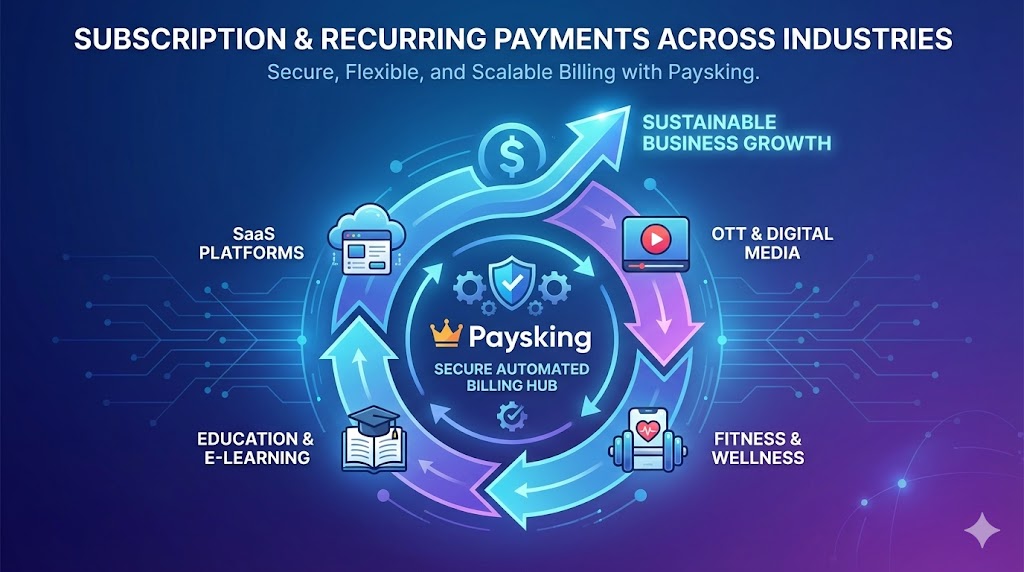
Subscription-based business models have transformed how companies generate revenue. From SaaS platforms and OTT services to education portals and fitness apps, recurring payments now power predictable growth and long-term customer relationships. However, managing subscription billing is far more complex than one-time payments. Failed transactions, renewals, compliance, and customer retention all depend on a robust recurring payment system. Paysking supports businesses across industries with secure, flexible, and scalable recurring payment solutions, enabling seamless subscription billing without operational friction. This guide explains how Paysking supports subscription and recurring payments, the challenges businesses face, and how modern payment infrastructure enables sustainable subscription growth. Rise of Subscription-Based Business Models The subscription economy has expanded rapidly across industries. 🔹 Why Subscriptions Are Growing Customers prefer convenience, while businesses benefit from recurring cash flow. Subscription Models Across Industries Subscriptions are no longer limited to software. 🔹 Common Subscription-Based Industries Each industry has unique billing requirements—but all depend on reliable recurring payments. Payment Challenges in Recurring Billing Despite its advantages, subscription billing introduces complex payment challenges. 🔹 Common Recurring Payment Problems Even a small failure rate can lead to significant revenue loss over time. Why Traditional Payment Systems Fail Subscriptions Legacy payment systems are often built for one-time transactions. 🔹 Limitations of Traditional Systems Recurring billing requires automation, flexibility, and reliability—not manual processes. How Paysking Handles Recurring Payments Paysking is built to support subscription-first businesses across industries. 🔹 Paysking Recurring Payment Capabilities These features ensure uninterrupted subscription revenue. Secure Subscription Billing Infrastructure Security is critical in recurring payments. 🔹 How Paysking Ensures Secure Billing Businesses can scale subscriptions without compromising customer trust. SaaS Payments with Paysking SaaS businesses rely heavily on recurring revenue. 🔹 SaaS Subscription Use Cases Paysking enables SaaS platforms to focus on product growth, not payment management. OTT & Digital Media Subscriptions OTT platforms require high-volume, seamless billing. 🔹 OTT Payment Needs Paysking ensures uninterrupted access by handling recurring billing efficiently. Education & E-Learning Subscriptions Education platforms increasingly rely on subscriptions. 🔹 Education Subscription Scenarios Paysking simplifies payment collection while supporting flexible pricing models. Fitness & Wellness Membership Payments Fitness apps and gyms depend on recurring payments for stability. 🔹 Fitness Subscription Challenges Paysking helps fitness brands retain members through reliable recurring billing. Managing Failed Payments & Retention Payment failures directly impact customer retention. 🔹 How Paysking Reduces Churn Recovering failed payments protects recurring revenue and improves retention. Real-Time Insights for Subscription Businesses Subscription businesses need visibility. 🔹 Paysking Provides This helps businesses optimize pricing, retention, and growth strategies. Why Paysking Is Ideal for Cross-Industry Subscriptions Different industries—one flexible solution. 🔹 Paysking Advantages for Subscriptions Whether you’re launching or scaling, Paysking adapts to your subscription needs. Final Thoughts: Recurring Payments Power Sustainable Growth Subscription and recurring payments are no longer optional—they are the backbone of modern digital businesses. However, success depends on reliable payment infrastructure that minimizes failures and maximizes retention. Paysking helps businesses across industries launch, manage, and scale subscription billing with confidence—turning recurring payments into a growth advantage.

Subscription & Recurring Payments Across Industries Read Post »

Simplifying Cross-Industry Payments with Paysking APIs

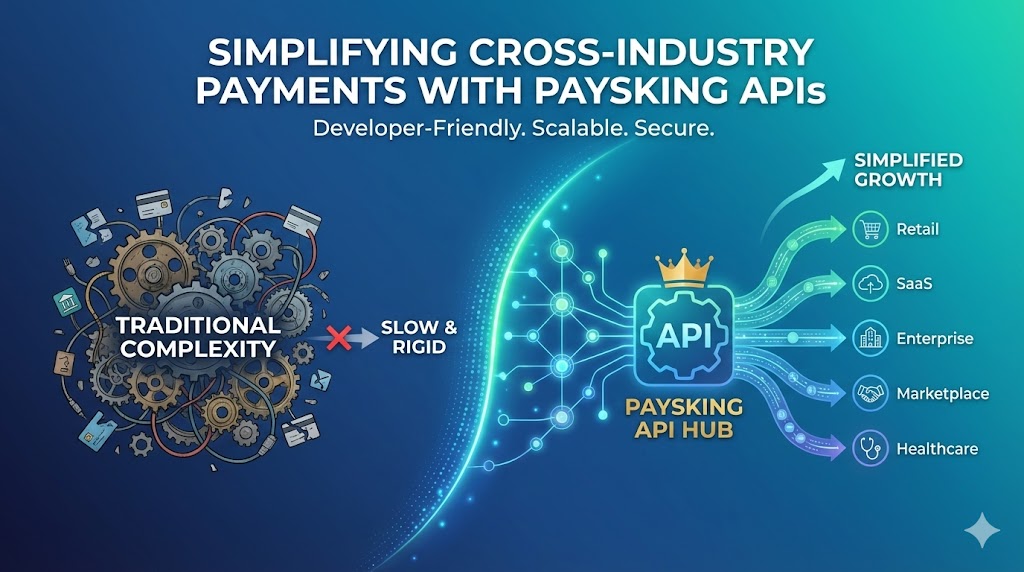
In today’s digital-first economy, businesses across industries—from SaaS platforms to online marketplaces—need fast, secure, and scalable payment systems. Traditional payment setups are slow, complex, and often built for a single use case. This is where payment APIs change everything. Paysking offers developer-friendly payment APIs designed to simplify payment integration across industries, use cases, and business models. Instead of rebuilding payment logic for every product or market, businesses can rely on a single, flexible API-driven payment infrastructure. This guide explains how Paysking APIs simplify cross-industry payments, the challenges they solve, and why API-first payments are the future of fintech integration. Why APIs Power Modern Payment Systems Modern payment ecosystems are no longer limited to one product, one platform, or one geography. Businesses operate across multiple channels, currencies, and customer touchpoints. 🔹 Why APIs Are the Backbone of Payments APIs make payments programmable, turning complex financial operations into simple, reusable building blocks. How Payment APIs Replace Legacy Payment Systems Traditional payment systems were: Payment APIs remove these limitations by allowing developers to integrate, update, and scale payments without disrupting core systems. 👉 Related reading:Scaling Business Payments Without Changing Platforms Common Integration Challenges Businesses Face Despite the promise of APIs, many businesses still struggle with payment integration due to poor infrastructure or outdated providers. 🔹 Most Common Payment Integration Problems These challenges delay go-live and increase development costs. Why Cross-Industry Payments Are More Complex Each industry has unique payment needs: Without flexible APIs, businesses are forced to build custom solutions for each scenario—leading to fragmentation and risk. Paysking API Capabilities Paysking’s payment APIs are designed with flexibility, scalability, and developers in mind. 🔹 Core Paysking API Features The result: faster integration with fewer dependencies. 👉 Related:How Paysking Supports Growth at Every Stage Developer-Friendly APIs That Reduce Complexity Paysking focuses on developer experience, not just payment processing. 🔹 What Makes Paysking APIs Developer-Friendly Developers can integrate payments without spending weeks decoding APIs. Security & Compliance Built into Paysking APIs Security is non-negotiable in payment systems. 🔹 Built-In Security Layers This allows businesses to focus on growth while Paysking handles payment security. 👉 Related:Why Secure Payment Infrastructure Matters for Modern Businesses Use Cases for SaaS Businesses SaaS platforms rely heavily on automation and recurring payments. 🔹 How SaaS Companies Use Paysking APIs Paysking APIs help SaaS businesses launch faster and scale globally. Use Cases for Marketplaces & Platforms Marketplaces require complex payment flows. 🔹 Marketplace Payment Scenarios Paysking APIs simplify these flows into manageable, programmable processes. 👉 Related:From Startup to Enterprise — A Single Payment Platform Use Cases for Enterprise & Custom Platforms Enterprises need reliability and customization. 🔹 Enterprise API Benefits Paysking APIs adapt to enterprise needs without rebuilding systems. Faster Go-Live with Flexible APIs Time-to-market is critical. 🔹 How Paysking Reduces Go-Live Time Businesses can move from development to production significantly faster. Why API-First Payments Drive Business Growth Payment APIs are not just technical tools—they are growth enablers. 🔹 Business Benefits of API-First Payments This makes APIs a strategic advantage, not just an integration layer. Why Businesses Choose Paysking APIs Businesses choose Paysking because it combines technical flexibility with business reliability. 🔹 Paysking API Advantages Paysking APIs grow with your business—not against it. 👉 Related:Why Businesses Trust Paysking for Scalable Digital Payments Final Thoughts: APIs Are the Future of Payments Cross-industry payments are only getting more complex. Businesses that rely on rigid, legacy systems will struggle to scale. Those that adopt flexible, developer-friendly payment APIs will move faster, innovate quicker, and serve customers better. Paysking APIs simplify payment integration across industries—turning payments into a competitive advantage instead of a bottleneck.

Simplifying Cross-Industry Payments with Paysking APIs Read Post »

Scaling Business Payments Without Changing Platforms

Growth is the goal of every business—but growth also brings complexity. As transaction volumes rise, customer bases expand, and business models evolve, payment systems are often the first to feel the strain. Many companies discover too late that their existing payment provider cannot keep up. This is why choosing a scalable payment gateway from the beginning is critical. Platforms like Paysking are built to support growing businesses and enterprise payments—without forcing costly platform changes as you scale. Payment Challenges During Business Growth As businesses grow, payment operations become more demanding. Common challenges include: A payment system that works for a startup may fail when the business reaches scale. Why Switching Payment Providers Hurts Scaling Switching payment providers during growth is rarely smooth. It often leads to: Instead of focusing on expansion, businesses end up firefighting payment issues. This is why long-term scalability matters more than short-term convenience. How Paysking Supports Growth at Every Stage Paysking is designed as a future-ready scalable payment gateway, supporting businesses at every phase of growth. Built for High-Volume Payments Flexible Payment Workflows Enterprise-Grade Security & Compliance From Startup to Enterprise — A Single Platform Paysking eliminates the need to “upgrade” payment providers as your business grows. For Startups For Growing Businesses For Enterprises With Paysking, growth does not require reinvention—it requires confidence. Why Growing Businesses Choose Paysking Businesses choose Paysking because it offers: Instead of changing platforms every few years, companies invest once—and scale indefinitely. Scale Confidently with Paysking Growth should be exciting, not disruptive. With Paysking, businesses can scale transactions, teams, and markets without worrying about payment limitations. Hashtags #BusinessScaling #EnterprisePayments #FintechGrowth #Paysking

Scaling Business Payments Without Changing Platforms Read Post »

Scroll to Top