
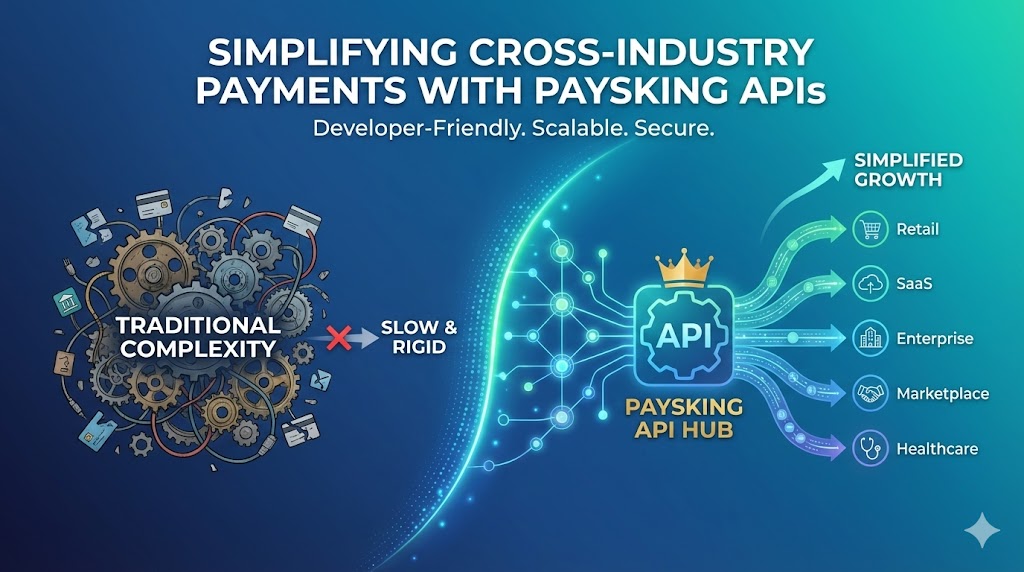
In today’s digital-first economy, businesses across industries—from SaaS platforms to online marketplaces—need fast, secure, and scalable payment systems. Traditional payment setups are slow, complex, and often built for a single use case. This is where payment APIs change everything.
Paysking offers developer-friendly payment APIs designed to simplify payment integration across industries, use cases, and business models. Instead of rebuilding payment logic for every product or market, businesses can rely on a single, flexible API-driven payment infrastructure.
This guide explains how Paysking APIs simplify cross-industry payments, the challenges they solve, and why API-first payments are the future of fintech integration.
Why APIs Power Modern Payment Systems
Modern payment ecosystems are no longer limited to one product, one platform, or one geography. Businesses operate across multiple channels, currencies, and customer touchpoints.
🔹 Why APIs Are the Backbone of Payments
- Enable modular payment architecture
- Support multiple payment methods
- Allow real-time data exchange
- Scale effortlessly as businesses grow
APIs make payments programmable, turning complex financial operations into simple, reusable building blocks.
How Payment APIs Replace Legacy Payment Systems
Traditional payment systems were:
- Hard-coded
- Slow to customize
- Expensive to maintain
- Difficult to scale
Payment APIs remove these limitations by allowing developers to integrate, update, and scale payments without disrupting core systems.
👉 Related reading:
Scaling Business Payments Without Changing Platforms
Common Integration Challenges Businesses Face
Despite the promise of APIs, many businesses still struggle with payment integration due to poor infrastructure or outdated providers.
🔹 Most Common Payment Integration Problems
- Complex documentation
- Limited payment method support
- Slow onboarding & approvals
- Poor error handling
- Lack of sandbox environments
These challenges delay go-live and increase development costs.
Why Cross-Industry Payments Are More Complex
Each industry has unique payment needs:
- SaaS needs recurring billing
- Marketplaces need split payouts
- Platforms need multi-merchant onboarding
- Enterprises need reporting & reconciliation
Without flexible APIs, businesses are forced to build custom solutions for each scenario—leading to fragmentation and risk.
Paysking API Capabilities
Paysking’s payment APIs are designed with flexibility, scalability, and developers in mind.
🔹 Core Paysking API Features
- Unified payment API for multiple use cases
- Support for cards, UPI, wallets & bank transfers
- Secure authentication & encryption
- Webhooks for real-time payment updates
- Easy reconciliation & reporting
The result: faster integration with fewer dependencies.
👉 Related:
How Paysking Supports Growth at Every Stage
Developer-Friendly APIs That Reduce Complexity
Paysking focuses on developer experience, not just payment processing.
🔹 What Makes Paysking APIs Developer-Friendly
- Clean REST-based architecture
- Clear and structured documentation
- Sandbox environment for testing
- Consistent request/response formats
Developers can integrate payments without spending weeks decoding APIs.
Security & Compliance Built into Paysking APIs
Security is non-negotiable in payment systems.
🔹 Built-In Security Layers
- Encrypted transactions
- Secure API keys
- Role-based access control
- Compliance-ready infrastructure
This allows businesses to focus on growth while Paysking handles payment security.
👉 Related:
Why Secure Payment Infrastructure Matters for Modern Businesses
Use Cases for SaaS Businesses
SaaS platforms rely heavily on automation and recurring payments.
🔹 How SaaS Companies Use Paysking APIs
- Subscription billing integration
- Automated renewals
- Failed payment retries
- Usage-based billing models
Paysking APIs help SaaS businesses launch faster and scale globally.
Use Cases for Marketplaces & Platforms
Marketplaces require complex payment flows.
🔹 Marketplace Payment Scenarios
- Multi-vendor onboarding
- Split payments and settlements
- Escrow-based transactions
- Real-time payout tracking
Paysking APIs simplify these flows into manageable, programmable processes.
👉 Related:
From Startup to Enterprise — A Single Payment Platform
Use Cases for Enterprise & Custom Platforms
Enterprises need reliability and customization.
🔹 Enterprise API Benefits
- High-volume transaction handling
- Custom workflows
- Advanced reporting
- Seamless ERP & CRM integration
Paysking APIs adapt to enterprise needs without rebuilding systems.
Faster Go-Live with Flexible APIs
Time-to-market is critical.
🔹 How Paysking Reduces Go-Live Time
- Minimal setup requirements
- Pre-built API endpoints
- Easy testing via sandbox
- Clear onboarding process
Businesses can move from development to production significantly faster.
Why API-First Payments Drive Business Growth
Payment APIs are not just technical tools—they are growth enablers.
🔹 Business Benefits of API-First Payments
- Faster product launches
- Lower development costs
- Improved customer experience
- Easier market expansion
This makes APIs a strategic advantage, not just an integration layer.
Why Businesses Choose Paysking APIs
Businesses choose Paysking because it combines technical flexibility with business reliability.
🔹 Paysking API Advantages
- Cross-industry compatibility
- Developer-first design
- Scalable architecture
- Secure & compliant infrastructure
- Strong support ecosystem
Paysking APIs grow with your business—not against it.
👉 Related:
Why Businesses Trust Paysking for Scalable Digital Payments
Final Thoughts: APIs Are the Future of Payments
Cross-industry payments are only getting more complex. Businesses that rely on rigid, legacy systems will struggle to scale. Those that adopt flexible, developer-friendly payment APIs will move faster, innovate quicker, and serve customers better.
Paysking APIs simplify payment integration across industries—turning payments into a competitive advantage instead of a bottleneck.